Finding Frederick Prentice – Aboriginal Digger – winner of the Military Medal

Tweet

Aboriginal-Flag

On the 10th of March 2008 a 1914-15 Star awarded to Indigenous digger, Frederick PRENTICE sold on ebay.

Frederick PRENTICE, Service Number 2597 was a member of the 12th Infantry Battalion, AIF during the Great War.  The First World War Embarkation Roll records his departure from Adelaide on the 26th of August, 1915 aboard RMS Morea with the rank of Private.  His service record via the National Archives of Australia indicates he arrived at Mudros during December 1915 and did not serve on Gallipoli.  This Aboriginal Australian was born in Powells Creek, Northern Territory and was the recipient of a Military Medal for his service on the Western Front; eventually attaining the rank of Corporal.  He saw considerable action including service at Pozieres, Bullecourt, The Somme and Passchendaele.  He died in Katherine in 1958 and was described as a ‘half-caste’ Maori by Police.

1914-1915-Star-Frederick-PrIMAGE RIGHT:  The First World War medal (1914-1915 Star) of Private Frederick PRENTICE who was one of many Aboriginal Australians who answered the call during the Great War.  This image appeared on the ebay listing at the time of the sale.  The research was conducted by Mostly Unsung Heroes.

The 1914-1915 Star was sold by a Sydney militaria dealer who unfortunately has an unscrupulous reputation.  Subsequently he is not prepared to assist in any way.  Medals Gone Missing is interested in contacting the winner of this auction.  We wish to point out that we have information which may interest the winner of this medal and we are not attempting to recover the award.  However, if this person is interested in selling the medal back to the descendants of Frederick PRENTICE, this may be negotiated.

Miltary-Medal-Frederick-PreIMAGE LEFT:  The Military Medal, similar to that awarded to Corporal Frederick PRENTICE, an Indigenous Australian who served in the Australian Imperial Force during the Great War.

Please CLICK HERE for a link to a story about Frederick PRENTICE.  If you would like to know more about Frederick’s history, you may contact Christine Cramer on the following email:-  [email protected]

PLEASE NOTE:  Medals Gone Missing wishes to point out that Colonel Neil C Smith OAM operating as “Mostly Unsung Military History Research and Publications” is a very reputable historian and is NOT the dealer referred to in the above text.  Nor is he associated with the Sydney based militaria dealer mentioned above.  Despite the fact that this emblem was not in existence during the time of the First World War, the Aboriginal flag has been used in this blog out of respect of all Indigenous Australians who have served (and continue to serve) in the Australian Armed Forces.


  • Delicious
  • Facebook
  • Digg
  • Reddit
  • StumbleUpon
  • Twitter
Posted in Military Medals | Leave a comment

Are you related to Herbert Henry KURTZ from Dubbo, New South Wales?

Tweet

Australian-FlagI am searching for the descendants of Corporal Herbert Henry KURTZ who served with the 3rd Infantry Battalion, Australian Imperial Force during the Great War.  He was born at Dubbo, New South Wales and lists his civil occupation as “Traveller” prior to joining he Australian Imperial Force.  His service number was 143 and he left Australia aboard HMAT Euripides (A14) from Port Sydney on 20 October, 1914 according to the First World War Embarkation Roll.  Herbert Henry KURTZ landed at Gallipoli on or around 25th April with the 3rd Battalion and according to his service record as per the National Archives of Australia, he was wounded during the August offensive.  Having sustained a gun shot wound to his leg, it is highly likely that he received this wound during the battle for Lone Pine where the 3rd Infantry Battalion was heavily engaged.

Britsh-War-Medal-&-Victory-IMAGE RIGHT: The British War Medal and Victory Medal, similar to that awarded to Corporal Herbert Henry KURTZ. He is also entitled to the 1914-1915 Star.

As a result of his injury and a bout of dysentery, Herbert Henry KURTZ was evacuated to Mudros and then sent to England for further treatment.  Perhaps as a result of his injury, he transferred to the Australian Army Pay Corps where he served for the remainder of the war.

Herbert Henry KURTZ may be related to F.A. KURTZ who served in the Merchant Navy during the Great War.  If you are related to this person, could you please contact the Medals Gone Missing Administrator.

3rd-Battalion-colour-patch-IMAGE LEFT:  The ‘brown over green’ color patch of the 3rd Infantry Battalion, Australian Imperial Force.

  • Delicious
  • Facebook
  • Digg
  • Reddit
  • StumbleUpon
  • Twitter
Posted in Military Medals | Leave a comment

Searching for the family of G. WHEELER – British Army number M2-182031 – Army Service Corps during First World War

Tweet

British-Flag

I am searching for the family of Private G.WHEELER who served with the British Army during the Great War.  At this time, I do not have any personal details about G. WHEELER other than he was a Private in the British Army Service Corps and his service number was M2-182031 and he came from the United Kingdom.

British-War-Medal-&-VictoryIMAGE RIGHT:  The British War Medal and Victory Medal awarded to Private G. WHEELER who served with the Army Service Corps during the First World War.  Both of these war medals are hanging from their original medal ribbon.

He may have immigrated to Australia after the First World War however there is no direct proof of this, other than the fact that his war service medals (British War Medal and Victory Medal) ended up in my father’s possession.  With the passing of my father, our family have absolutely no idea how they ended up amongst his belongings.

Missing-medals-British-War-IMAGE LEFT: The British War Medal and Victory Medal awarded to M2-182031 Private G. WHEELER, clearly showing his service number.

I wish to re-unite these missing war medals with a direct descendant of G. WHEELER but at this time I have very little to work on, in terms of his identity.  We have no idea of his first name, his town of birth or who his next of kin was.

M2-182031-Private-G.-WHEELEIMAGE RIGHT: The medals are impressed with the name of the medal recipient, G. WHEELER.  With the Centenary of the First World War now upon us, I am hoping to find his direct descendants as his missing medals are an important part of his family history.

We have conducted a thorough search of the CWGC (Commonwealth War Graves Commission) records and there does not appear to be a man by the name of G. WHEELER (service number M2-182031) of the Royal Army Service Corps who lost his life during the Great War.  Also, the medals appear to be well worn which may suggest they were used by the recipient for many years during commemorative functions.

Royal-Army-Service-Corps-miIMAGE LEFT:  The British War Medal and Victory Medal of Private G. WHEELER showing that he was a member of the Army Service Corps.  Also sometimes recorded as the Royal Army Service Corps.

I come from a military family and I know how important war service medals are.   If anybody is a direct descendant of G. WHEELER whose service number was M2-182031 then I would very much like to hear from you.  The missing medals are not for general sale and their return will be upon strict proof of relationship.

  • Delicious
  • Facebook
  • Digg
  • Reddit
  • StumbleUpon
  • Twitter
Posted in Honour Roll - British Stories, Military Medals, Missing Militaria - Now Found! | Tagged , , , | Leave a comment

Are you related to Craftsman Albert Leslie AXTON – Second World War dog tags found with metal detector

Tweet

Australian-FlagAre you related to Craftsman Albert Leslie AXTON from Victoria, Australia?  If so, we would like to hear from you!

Second World War identification tags pertaining to Craftsman Albert Leslie AXTON have been found.  Born in Wycheproof, Victoria (Australia) Albert Leslie AXTON joined the AMF (Australian Military Forces) commonly referred to as ‘Militia’ and was allocated the service number V47875.  On 18 August, 1942 he transferred to the AIF (Australian Imperial Force) and his service number changed to VX102549.  The
World War Two Nominal Roll indicates his unit of discharge was 2/55 Australian Light Aid Detachment.

AXTON-albert-leslieIMAGE RIGHT:  The identification tags of Craftsman Albert Leslie AXTON.  Amazingly they were found by a fossicker in North Queensland with a metal detector.  Through the efforts of a very generous person from Western Australia, it is his wish that they are returned to a direct descendant of Albert AXTON.

These two identity tags are believed to be “kit” identification tags, usually attached to Australian duffle bags or kit bags during the Second World War.  This was especially the case when a soldier was in transit; or receiving treatment in a military hospital and he was temporarily separated from his belongings.  Alternatively, I have heard that tags such as this may also be attached to a bed in a military hospital or a camp.  These two tags are not impressed by a military stamp press, rather they have been hand engraved/scratched into the surface.  They were very generously donated by a gentleman who indicated he acquired the tags from a prospector; the discs being located using a metal detector on Atherton Tableland in North Queensland.

It was indicated a military hospital was located at the place in question, where servicemen from Australia, New Zealand and some U.S. personnel were treated during the 1939-1945 war.  After the cessation of hostilities, a large reservoir was built and the locality of the hospital became submerged underwater. When the water levels subsided, the prospector swept the area with his metal detector and the tags (along with a number of others) were located.  If you are a descendant of Albert Leslie AXTON, please contact the Medals Gone Missing Administrator.  The dog tags are NOT for general sale and will only be returned to a direct descendant of Albert Leslie AXTON upon strict proof of relationship.

  • Delicious
  • Facebook
  • Digg
  • Reddit
  • StumbleUpon
  • Twitter
Posted in Military Medals | Leave a comment

Kitchener’s Volunteer – Missing War Medals sought of Ernest Michael TAYLOR – Royal Field Artillery

Tweet

British-Flag

Ernest Michael Taylor was born 9 March 1891on 90 Doncaster Street, Saint Martin, Liverpool, England.  His parents, Joseph Taylor of Co. Waterford, Ireland, a bookkeeper, and Catherine O’Brien of Liverpool were staunch Irish Catholics whose families had immigrated to England.  He was the eldest of three other siblings, William born 1897, Joseph born 1898, and Mary Josephine born 1889.  In 1911, the family relocated to Halifax, Yorkshire West Riding.  By this time, Ernest was 20 years old and his occupation was listed in the 1911 English census as “Giving Olet Caus Of Dry Flar Carpet Losens.”  In fact, the entire family was employed at the carpet making business called ” Lin Winder Carpet Makers”. His father had passed away by this time, leaving his mother Catherine the head of the household.

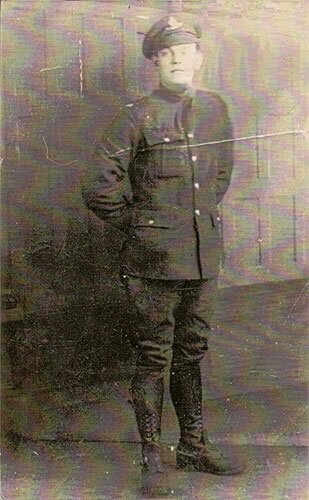
Corporal-Ernest-Michael-TAYIMAGE RIGHT:  Studio portrait of Ernest Michael TAYLOR, service number 1307.  When mentioned in the Supplement to the Edinborough Gazette on 26 February 1918 his rank was listed as Corporal and his Regimental Number 675383

Ernest eventually joined the military, probably one of Kitchener’s volunteers, and was trained as a Gunner (Regimental number 1307) in the Royal Field Artillery (R.F.A.).  He deployed to France 29 September 1915.  In only a few short years, he was promoted to Sergeant, with a new Regimental Number 675383.  I am unsure why the number changed and how he was promoted so quickly, but perhaps he was wounded and, following recovery, was posted to a new Regiment withing the R.F.A. or to a training establishment.  Many of my family members have served in the military, and have a tendency to speak little of their hardships, and thus we have forgotten the story.  Ernest was awarded the 1914-1915 star, the British War Medal and the Victory Medal.

Military-Medal-Corporal-ErnIMAGE LEFT:  Late war portrait of Ernest Michael TAYLOR mounted on a charger.  It is believed this image was taken after he was awarded the Military Medal, as he is wearing the rank of Sergeant.

After the war, Ernest opened a tobacco shop and married Victoria Annie Whitelock on 28 Feb 1920.  She died later that year in childbirth.  Ernest then married Rebecca Kane in West Derby Lancashire on 20 November 1921 and they had ten children together.  While Ernest ran the Tabacco Shop, Rebecca helped to make ends meet by working as a waitress.  They lived in a small home on 65 Argos Road in West Derby, Liverpool.  Their first child, my Grandmother Catherine Josephine Taylor, recalls how crowded the home was and how often she would babysit her siblings.  She recalls being a second mother to her siblings, cooking for them, bathing them, and putting them to bed.

At one point, the family was badly in need of money, and so the decision was made that Rebecca would pawn Ernest’s medals to “put food on the table” as my Grandmother recalls.  Rebecca gathered up all the kids and walked to a local pawn shop where she sold the medals with the intention of returning to buy them back after payday.  My grandmother Catherine recalled that payday was only one or two days away at the time her mother Rebecca sold the medals.  When Rebecca returned to buy back the medals, they had been sold.  Distraught, she returned home.  She and Ernest had a huge row and Rebecca ended up smashing the portrait of Ernest on horseback during the war.

Royal-Field-Artillery-cap-bIMAGE RIGHT:  The cap badge of the Royal Field Artillery.

Ernest died 7 December 1955 in Liverpool at the age of 64.  He is buried in Yew Tree Cemetery.  My grandmother was extremely proud of her father’s service in the Royal Field Artillery.  She never spoke to her children about her past, but she told me about her whole life when I was around sixteen years old – this was a few years before she died.  She was a practical woman who was more concerned with feeding her family than she was with treasured heirlooms, but the loss of these medals bothered her deeply because of the resentment their loss created between her parents.  I wanted to please my Nan by finding these medals.  Now that she has passed, I would like to give them to her sister in England.

This story was composed by Tony ROSS, the great grandson of Ernest Michael TAYLOR of Great Britain.

  • Delicious
  • Facebook
  • Digg
  • Reddit
  • StumbleUpon
  • Twitter
Posted in Military Medals | Leave a comment