
 2718 Private Walter Tracey DCM
Walter TRACEY was a member of D Company, 7th Battalion, 2nd Australian Infantry Brigade, 1st Australian Division during the First World War. This Battalion fought at Gallipoli and then was sent to the Western Front, suffering 1,045 killed and 2,076 wounded. The 1,045 killed makes one reflect on the horrors of the Great War, as the losses in this battalion alone exceed the total combined Australian war deaths in Korea, Vietnam, Iraq and Afghanistan.
The 7th Battalion took part in the ANZAC landings at Gallipoli on 25 April 1915, and news of the losses must have reached Australia in May and June, because there was a drive to recruit reinforcements by mid year.
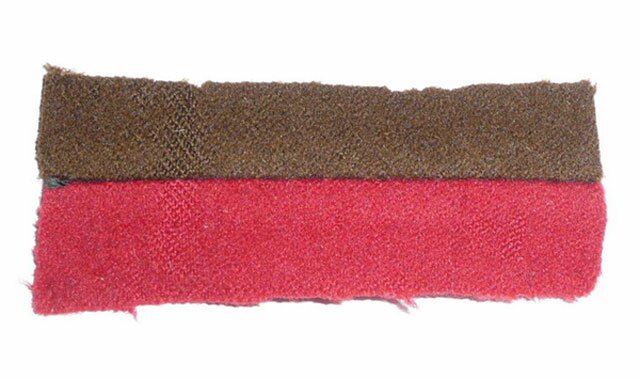 IMAGE RIGHT: The ‘brown over red’ colour patch of the 7th Infantry Battalion, AIF. Whilst this is an original First World War colour patch, it is quite unusual in terms of its length. According to Divisional Orders, No.81, para 562 of the 8 March 1915, a directive was issued in regards to the rectangular patch of the 1st Division in that:- ‘In order the better to distinguish the several units of the Division, coloured badges of cloth, (1 & 1/4 inches wide by 2 & 3/4 inches long), will be worn on the sleeve one inch below the shoulder seam.’ This order only applied only to the 1st Division and not the 4th Brigade. By February 1917 (and onward) amendments were being made to particular 1st Division units in which the dimensions of (1 & 1/2″ x 2 & 1/2″) were adopted.
Walter Tracey was a 32 years old labourer ( 9 stone and 5 feet 4inches ) when he enlisted at Bendigo on 19 July 1915 and was assigned to the 8th Reinforcement, 7th Battalion on 24 August. According to the First World War Embarkation Roll, Walter boarded HMAT Anchises (A68) at port Melbourne on the 26 August, 1915 and sailed for overseas service. He joined the battalion at Sarpi camp, LEMNOS on 20 November 1915, spent time with the unit in Alexandria before sailing to Marseilles on 31 March 1916.
Like most reinforcement troops, I assume that Tracey as shunned by the original members of the unit, and he fought for acceptance and recognition by being ‘brave’. His citation reads:
“At Pozieres on 25th July 1916 7th Battalion was employed in repulsing German Counter attacks and No. 2718 Private Tracey W. of 7th Battalion. One of a party was conspicuously brave in repelling and delivering counter attacks. With this party (whose name has been submitted for awards) Private Tracey endangered his life time and again under fusillades of grenades and snipers fire while building barricades and bombing and constantly got the enemy on the run by rushing along the parapet throwing grenades and sniping down on the enemy. With this party Private Tracey did excellent work in bombing and detonating regardless of the great danger he was in. Private Tracey remained with Captain Oates holding the trench while a barricade was built in rear when our attacking party had to fall back owing to lack of detonated bombs. While with Captain Oates, Pte Tracey displayed coolness and judgement in a very dangerous situation. On Captain Oates return to trenches prior to going forward to front line in answer to request from 9th battalion. For his assistance Pte Tracey volunteered to accompany Captain Oates again. Recommended by Captain Oates and Lieut Bowtell-Harris. Recommended for V.C. Awarded D.C.M.”
Captain Oates was awarded a DSO for the same action, and then a Military Cross at the Khyber Pass in 1920 while serving in the Indian Army.
Three weeks after this action, and a week after being awarded the DCM, Private Walter TRACEY received gun shot wounds to both thighs. He was evacuated to England on 28 August 1916, and returned to Australia on 10 October 1917.
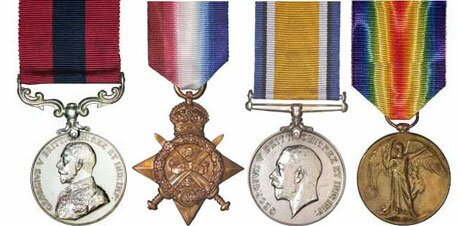 IMAGE LEFT: The Distinguished Conduct Medal with the 1914-1915 Star, British War Medal and Victory Medal as per the medal entitlement of Private Walter TRACEY. These war service medals are missing. Can you help?
Walter’s war service medals are missing and are being sought by his family. Whilst these medals are very collectable, it is hoped that whoever may have these missing war medals in their possession may consider donating or selling them back to his descendants. Alternatively, should the person who has these medals in their collection not wish to part with the medals, could you kindly advise the family of Walter TRACEY that the medals are safe and being cared for.
Story supplied by John TRACEY.


