

CORPORAL WILLIAM JOHN McDONALD
640 – 2nd Tunnelling Company
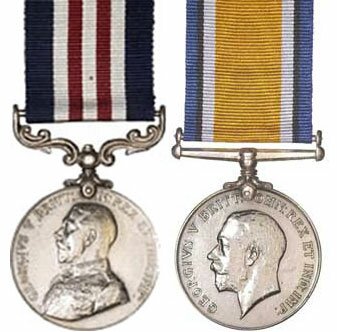 IMAGE LEFT: The Military Medal and British War Medal of Corporal William John McDONALD are missing. His South Africa Service medals are also lost to his family. Can you help?
William John (William James Grant) McDonald was born at Inverness, Scotland about July 1877, the son of James Grant, diver, and Celia Alexander (nee Nelson) McDonald, arrived in Melbourne around 1902.
Long before the simmering pot which was Europe boiled over into the Great War, William found himself in a war zone. The British were at war with the Boers in South Africa and William would see service with Brabant’s Horse. This force was a British South African Irregular unit of some repute. Cape Colony and Natal were British colonies (much like NSW and Victoria in Australia) and like Rhodesia, were on side of the British side. Brabant’s Horse was similar to any of the Australian Mounted Rifle units and indeed from time to time, was brigaded with the Australians. Serving with this unit, it is believed that William was entitled to the Queens South African medal (QSA) with 4 clasps. These clasps being:- Cape Colony, Orange Free State, Transvaal and South Africa 1901. Further to this entitlement, it is believed that he was entitled the British South African Company medal for Rhodesia with the clasp 2nd Matabele Campaign. This medal had been approved by the British Government and Queen Victoria and according to this, is essentially an approved decoration. The BSAC essentially owned Rhodesia and was a ‘Government ‘ in its own right under the crown.
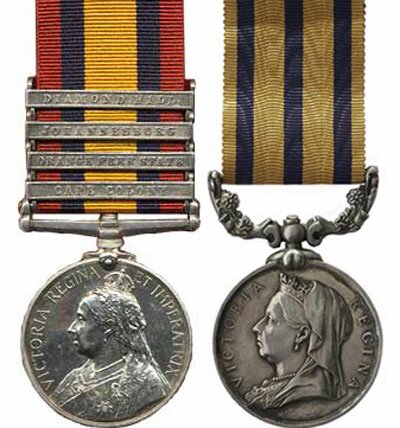 IMAGE RIGHT: The Queen’s South Africa Medal (Q.S.A) and the British South African Company Medal 1890 – 1897 believed to have been awarded to William John McDONALD for his service in South Africa and during the Boer War.
After his service in South Africa, William married Harriett Louisa Quinton in Melbourne on the 25th of August, 1904 and settled in the suburb of Richmond. Harriett had a child named Percy Edward Quinton in 1902, from a previous relationship and William took him on as his own. Sadly, the first attempt by William and Harriet to have their own children end in partially in tragedy. Giving birth to twins on the 19th November, 1904 – one child christened “Benjamin James” died on the first day. His twin sister however, named “Violet Elizabeth” was fit and healthy and survived till she was 93 yrs old. By 1914 the couple were supporting seven children. Then from 1906 to 1919 they have another 7 children. 8 all up;)
William was in possession of a letter dated the 15th of August, 1914 from the Honorary Secretary of the South African Soldiers’ Association of Australia addressed to a Captain Lyons (Supply Officer) of Broadmeadows Army Camp. The letter advised that William was an experienced Army cook and in urgent need of employment. It was requested that some form of employment be found for William in the new AIF being formed. Captain Lyons forwarded the letter on to a Major Holdsworth with the notation “Can you let this man in?”
Major Holdsworth duly enlisted William in the Australian Imperial Force (A.I.F.) on the 18th of August 1914 at Melbourne, Victoria.
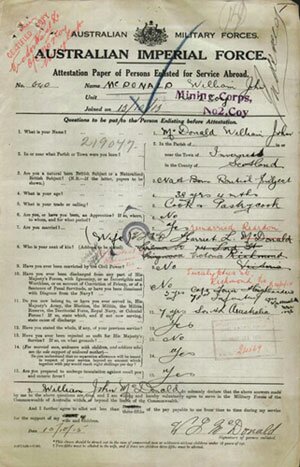 IMAGE LEFT: The Attestation Form of Private William John McDONALD upon his original enlistment into the Australian Imperial Force.
He signed the ‘Attestation Paper of Persons Enlisted for Service Abroad’ and the Oath to ‘well and truly serve’ on the 21st of August. A medical examination on same day had found him to be ‘fit for active service’ and recorded that he was 38 years and 2 months of age, standing 5ft 5ins tall and weighing 9 stone 3 lbs. He had a dusky complexion, blue eyes and brown hair. William’s trade was listed as ‘cook’ and that he was a good horseman.
He named as Next-of-Kin; his wife Mrs Harriet Louisa Jane McDonald of 162 Mary Street, Richmond, Victoria and recorded previous military service as:
7 years with 78th Infantry Battalion, South Australia, attaining the rank of Corporal. He also claimed 2 years with the 2nd Brabant’s Horse in South Africa (number 20178 from the 31st of October 1900 – discharged on the 15th of May, 1901) and 8 Years with the Cape Highlanders.
William also recorded 1 year of service in the Matabele War in 1896 as a Trooper with “A” Troop, AfriKander Corps. Based on this, William was a very experience campaigner indeed.
Recruited into the Head Quarters Company, Divisional Train, Australian army Service Corps; William served as a Private soldier with the service number 352 and embarked from Melbourne on 19 October 1914 on board HMAT A 24 Benalla for the Middle East. Like many soldiers in these times, William somehow transgressed whilst in Suez and was awarded 24 hours detention as a result.
William was admitted to 15 General Hospital in Alexandria on the 15th of June 1915 and was transferred by Hospital Train to Cairo the following day. He was admitted to Abbassiah Hospital on this same day, being the 16th of June.
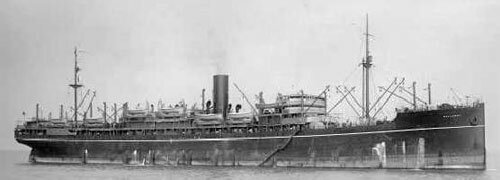 IMAGE RIGHT: William returned to Australia on board the Hospital Ship Ballarat, leaving Cairo on the 3rd of July and arriving in Australia on 6th of August, 1915. After sometime in the Langwarrin Hospital, he was returned to Melbourne and discharged from the A.I.F. on the 8th of October, 1915. HMAT (His Magesty’s Australian Transport) Ballarat which conveyed William back to Australia before his first discharge from the AIF.
Not wasting any time, William again enlisted into the A.I.F. just one week after his discharge, on the 15th of October 1915. He signed his ‘Attestation Paper’ and the Oath for the second time and began training with the 24th Depot Battalion.
His details this time were recorded as 38 years and 4 months of age, 5ft 5ins tall, weight 9 stone 6 lbs, medium complexion, blue eyes and dark hair. Tattoos on both forearms and a scar above his right eye were recorded as distinguishing marks.
He again named his wife Mrs Harriet Louisa McDonald as his Next-of-Kin, recording her address as 74 Lord Street, Richmond, Victoria, and allotted three-fifths of his pay for the support of his wife and 7 children.
On the 6th of November he was appointed to No.2 Company of the newly formed Australian Mining Corps and trained with them at their Casula Camp until he embarked on Ulysses for the European theatre.
Following a farewell parade in the Domain, Sydney, the Australian Mining Corps embarked from Sydney, New South Wales on 20 February 1916 on board HMAT A38 Ulysses. The Mining Corps comprised of 1303 members at the time of embarkation with a Headquarters of 40; No.1 Company – 390; No.2 Company – 380; No.3 Company – 392, and 101 members of the 1st Reinforcements.
HMAT Ulysses arrived in Melbourne, Victoria on the 22nd of February and the Miners were camped at Seymour while additional stores and equipment were loaded aboard. Departing Melbourne on the 1st of March, Ulysses sailed to Fremantle, Western Australia where additional members of the Corps were embarked. However the ship grouned on an “unchartered rock” whilst leaving Fremantle, resulting in a delay of about one month. The Mining Corps sailed for the European Theatre on the 1st of April 1916. By this time, the men on board had nicknamed her ‘Useless’.
The ship arrived at Suez, Egypt on the 22nd of April, departing for Port Said the next day; then on to Alexandria. The Captain of the ship was reluctant to take Ulysses out of the Suez Canal because he felt the weight of the ship made it impossible to manoeuvre should a submarine attack occur. The Mining Corps was subsequently transhipped to B1 Ansonia for the final legs to Marseilles, France via Valetta, Malta. Arriving at Marseilles on the 5th of May, most of the men entrained for Hazebrouck where they arrived to set up their first camp on the 8th of May 1916.
A ‘Mining Corps’ did not fit into the British Expeditionary Force structure, and the Corps was disbanded and divided into three Australian Tunnelling Companies. The Technical Staff of the Corps Headquarters, plus some technically qualified men from the individual companies, were formed into the entirely new Australian Electrical and Mechanical Mining and Boring Company (AEMMBC), better known as the ‘Alphabetical Company’.
On the 3rd of July, 1916 William was admitted to the 1st New Zealand Ambulance with lumbago and was transferred to No.5 Canadian General Hospital at Boulogne with gastri-enteritis on 5th July. He was evacuated to England on the 6th July and admitted to the No.3 Camp Hospital at Harefield the following day.
Discharged from Hospital to No.1 Command Depot, Perham Downs on 9 August he was granted furlough, returning to Perham Downs on the 30th of August.
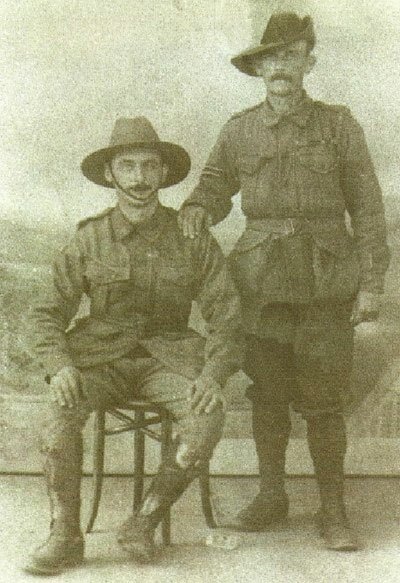 IMAGE LEFT: Photograph of Corporal William John McDONALD (standing on the right) with an unknown soldier. As he did not receive his second stripe until the 1st of September, 1916 – it is obvious that this photograph was taken after this date.
He was promoted Corporal on the 1st of September, 1916 and transferred to the 2nd Australian Tunnelling Company. On the 21st of September, William proceeded overseas to France, marching into the 2nd Australian Divisional Base Depot at Etaples. He joined the 1st Anzac Entrenching Battalion on 16th October. He was then attached to the 1st Canadian Tunnelling Company on the 26th of October and was wounded in action whilst attached to this unit on the 13th November, receiving a shell wound to the face. As a result of this wound, he was admitted to the 4th London Field Ambulance and discharged back to his unit on the 16th of November.
On 29th of November he was admitted to the 41st D.B. Station for dental treatment and returned to duty on the 12th of December. He rejoined the 1st Canadian Tunnelling Company on 12th December and on 17th December he was admitted to the 2nd Casualty Clearing Station with bronchitis; and was not discharged to duty until 18 January 1917.
On the 4th of December his Next-of-Kin was advised that he had been wounded. The letter was sent to Mrs. H.L. McDonald, Wiloma Street, Ringwood, Victoria.
On 31st of January 1917 he was taken on strength of the 3rd Australian Tunnelling Company from the 2nd Australian Tunnelling Company. The 3rd Company was working in the Hill 70 Mining System constructing fighting points in the Support Trenches and extending tunnels in the mainly hard chalk Gordon and Cameron workings. During the short time he was with them, the Company lost 5 men to enemy action.
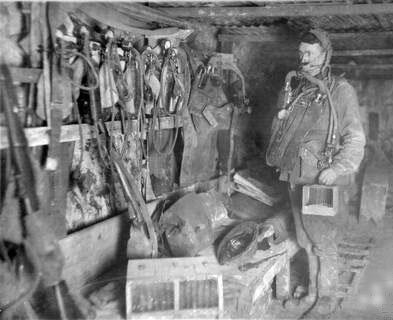 IMAGE RIGHT: A mine rescue station belonging to the 3rd Tunnelling Company at Hulluch Tunnels near Loos in January 1918. This is around the time that William was attached to the unit which was involved in extensive tunnelling activity. It is believed that William may have worked as a miner in Rhodesia and thus, this could be a reason why he was recruited for the tunnelling company.
On the 18th of February, William was transferred and taken on strength of the 2nd Australian Tunnelling Company. On the 4th of April 1917 it was recorded that his Next-of kin address had changed to 69 Chestnut Street, Richmond.
On the 26th June he was admitted to 2nd Field Ambulance with NYD (not yet diagnosed), rejoining his unit on the 4th of July. Within a matter of days, the 2nd Company was moved to the Nieuport-Bains region to prepare the area for a major British attack on the area. The area they were working in was heavily shelled on 10th July and more than 4o of the Australian Tunnellers were taken prisoner.
[see Western front/2nd Australian Tunnelling Company/Nieuport-Bains Affair on this site]
William was admitted to 28th Field Ambulance on 10th of November, 1917 with ‘NYD Chest’ and on 15th November he was transferred to the 13th General Hospital at Boulogne with bronchitis. On 17th November he was evacuated to England on the Hospital Ship ‘Jan Breydel’ and admitted to Connaught Hospital, Aldershot with bronchitis, slight. On 19 December he was transferred to the 3rd Auxiliary Hospital at Dartford and was discharged to furlough on 20th of December, 1917.
He reported to Hurdcott on the evening of 4th January 1918, one day later than he had been directed to and was charged with being absent without leave for that day. The offence earned him a reprimand and the forfeiture of 2 days pay.
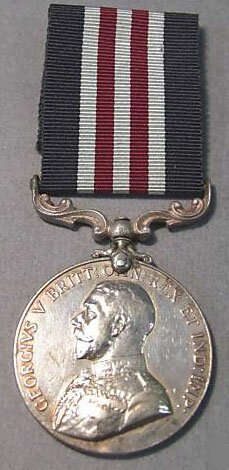 IMAGE LEFT: The Military Medal (M.M.) as awarded to William for his actions in France.
On 8 February, 1918 he was awarded the Military Medal for bravery in the field. No record can be found of the recommendation for this award, but it is believed that it may be related to the Nieuport-Bains Affair.
William left England 12th of March, 1918 on board the Kenilworth Castle transhipped to the Field Marshall at Durban on 28 April, arriving in Australia 22nd May, 1918. His documents record that he had been gassed.
He was Discharged from the A.I.F. at Melbourne on 13 July 1918 – ‘medically unfit – disability – gassed’, entitled to wear the 1914/15 Star, the British War Medal and the Victory Medal alongside his Kings and Queens South African Medals for his service in the Boer War.
On the 19th of July 1918 he was advised that the award of the Military Medal had appeared in the London Gazette, Second Supplement, No. 30507 dated 1st February 1918, and had also been promulgated in the Commonwealth of Australia Gazette No.95, dated 27 June 1918.
William John McDonald died on 12 April 1921 at the Austin Hospital, Melbourne of Pulmonary Tuberculosis. He was 43 years of age. He was buried in the Box Hill Cemetery on 14th of April, 1921 and lies at rest in a grave for life with his wife Harriett, Harriett’s second husband George Reardon, his son Thomas and his daughter Violet.
Williams’ 1914/15 Star was received by his widow on 23 June 1920, his British War Medal on 16 June 1921.
In December 1924, the Repatriation Commission, Melbourne, sought advice on the current address of Williams’ widow, as a letter addressed to her 441 Church Street, Richmond address had been returned.
In January 1925 Williams’ Victory Medal was issued to his widow, since re-married and now Mrs. H. L. Reardon of 441 Church Street, South Richmond. In August 1925 his particulars of service were provided to the Repatriation Commission.
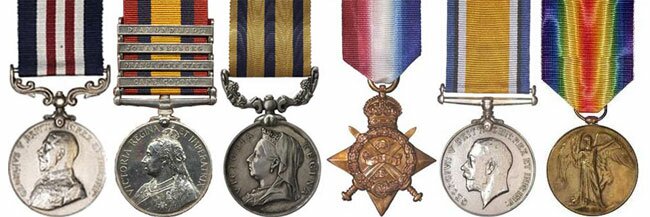 IMAGE RIGHT: The Military Medal, the Queens South Africa Medal (QSA), British South Africa Company Medal 1890 – 1897, 1914-1915 Star, British War Medal and Victory Medal as awarded to Corporal William John McDONALD. Whilst it is not confirmed, this is believed to be his full entitlement.
In June 1967 Williams’ son Reginald applied for the Gallipoli Medallion in respect of his father. He completed the formal application in July 1967.
As stated, William’s Military Medal , QSA (Queens South Africa Medal) British South Africa Company Medal 1890 – 1897 and British War Medal are missing and his descendants would dearly love to locate them so that they can be re-united with his other war medals. If you could help this family, they would be most appreciative. Please contact the Medals Gone Missing Administrator if you can help.
This story was composed by © Donna Baldey 2010
with the assistance of Erin Ritters, great granddaughter of William McDonald.
It was reproduced on the Medals Gone Missing website by courtesy of Erin Ritter.


